
Forsyth Ethics Panel Members Use "Stupid Defense" to Justify Allowing Conflicted Attorney to Participate in Howard Complaint Outcome
Panel Hands Hen House Keys to Proverbial Fox

The Stupid Defense
Over the years, I have found that one of the most difficult interpersonal tasks I ever have to undertake is to try to explain to someone why he or she owes me money, when he or she does not want to pay. It does not happen often, but when it does, it is not uncommon that such a person suddenly loses all ability to understand English. I have come up with a term to describe that mannerism. The purposeful inability to mentally grasp what should be painfully obvious, when one’s understanding would come at a cost, is what I call, the “stupid defense.” It is a form of gaslighting. To such an individual one might honestly explain, “Look, Fred, you borrowed $100 from me last week and agreed to pay me back this week. Now, it is time for you to pay me back.” Cornered by the facts, the kind of individual I describe seemingly becomes stupid, answering something like, “I don’t understand why you would say that. I have to go now.”
The mannerism I call the “stupid defense” can be used in many circumstances, such as child being caught with his hand in the cookie jar and refusing to admit his crime, imagining that stonewalling and refusing to acknowledge what is painfully obvious might get him off without time served. You see, either an individual using the stupid defense really is stupid, or he thinks you are stupid enough to believe him. The stupid defense can be used in either scenario.
Forsyth County Ethics Process is a Sh*t Show
Citizens of Forsyth County should know that their local government is running what is commonly known as a “sh*t show” in the administration of its ethics rules and procedures, three recent ethics panel judges apparently ignoring, and perhaps breaking the rules themselves, while employing the stupid defense mannerism to justifying their actions. Those three ethics panel members allowed a known, conflicted county attorney, Christopher Balch, appointed to his position by a resolution written, proposed and approved by the same six public officials who were the subjects of the ethics complaint before the panel, to sit among the panel members at the table and provide legal advice potentially affecting their decision to dismiss the case against Balch’s bosses. But that is not all. That same trio of panelists then handed the conflicted attorney the task of writing the decision exonerating the very bosses who appointed him and who pay him $400/hr out of public funds for his work, in essence handing the proverbial fox the keys to the hen house. And those three attorneys, comprising a recent Forsyth County ethics panel, apparently cannot understand what is wrong with any of that, claiming publicly that neither Balch nor his arguments had any effect on their decision to exonerate Balch’s employers—a prime example of what I call the ‘stupid defense’ at work in the heart of Forsyth County Government. Apparently, those panelists are truly stupid themselves, completely misinformed by a lack of due diligence on their parts, or they think the people of Forsyth County are stupid enough to believe them.

Speaking for the three panelists during the recent appeal of the panel’s decision, panel Attorney David Will would claim,

To further the public impression that Balch had no influence over the panel’s initial decision to exonerate Balch’s bosses, during the motion-to-vacate proceedings last Monday the three panelists actually took a vote among themselves to say the county ethics attorney had no influence on their decision, as if such a vote would be meaningful in view of the fact that it was Balch’s biased legal theory, arguing that the panel lacked jurisdiction to act on the complaint before them, that became the rationale by which the panel members initially dismissed Mr. Howard’s complaint after an hour of deliberation.
The Initial Investigatory Review
In my recent article entitled, “How the Forsyth County Commission Used Public Funds to Bail Themselves Out of Ethics Charges,” I brought evidence to show how the four members of the Forsyth County Commission—Laura Semanson, Mendy Moore, Kerry Hill, and Chairman Alfred John—used taxpayer dollars in a way that aided their own defense against an ethics complaint filed by Mr. Howard filed November. Apparently reacting to Howard’s filing, on December 4th those six public officials choreographed the passage of a resolution authorizing attorney Christopher Balch to provide legal services relating to Howard’s ethics complaints against them, eventually resulting in a dismissal of the complaint by the three-member ethics panel I reference above, as reported by Forsyth County News.
To justify his participation with the ethics panel at the investigatory review meeting, Mr. Balch assumed the guise afforded by the six Respondents in their resolution, playing the role of an outside attorney having no relationship with his appointers, and only representing the interests of Forsyth County as an institution, while, as reported by FCN, simultaneously presenting himself as representing the interests of the ethics panel as its “outside counsel,” yet another potential conflict of interests. In my referenced article, I provided conclusive video and documentary evidence that although the resolution was orally proposed to the commissioners as a limited measure allowing Balch to merely advise the county manager and the ethics clerk, it was ultimately used to expand Balch’s activities to encompass the entire county ethics process, even seating the Respondents’ chosen attorney at the investigatory review table, providing him the opportunity to influence the three-member ethics panel judging the merits of Mr. Howard’s complaint against them. Doing so created serious conflicts-of-interests concerns. The officials drafting, proposing and approving the appointment of Balch last December, were themselves the subjects of the complaints Balch would have a hand in dismissing.
During the initial ethics panel hearing, despite prohibitions in the county’s ethics rules, the panelists allowed Mr. Balch to present a case for dismissal of Mr. Howard’s complaint, holding to a theory that the ethics panel had no jurisdiction to act on a complaint pertaining to any alleged breaking of state law. The panel agreed with Balch’s unauthorized, biased and conflicted presentation and dismissed the complaint on the grounds Balch laid out for them.
Mr. Balch’s argument is refuted by Sec. 2-82 of the county ethics ordinance, which makes it an ethics violation to violate state law while engaged in any activity applicable to an official or employee by virtue of his respective office or employment. The county ethics rules therefore provide jurisdiction for the ethics panel to draw conclusions of law.

To enforce Sec. 2-82 above, Sec. 2-124(5) provides the ethics panel jurisdiction to determine conclusions of law.

And when an ethics panel determines that a state law has been broken, the Sec. 2-125(e) provides authority to refer its finding of facts and conclusions of law to the county district attorney.

Scott Howard’s Motion to Vacate the Panel’s Dismissal
After reading of the panel’s initial decision in the local paper, Mr. Howard filed a motion to vacate, or nullify, the panel’s decision to dismiss his complaint. He did so on the grounds that Mr. Balch was an unauthorized participant in the earlier meeting, and that Balch himself had conflicted interests. Mr. Balch’s presence at the table was not authorized because the county ethics rules only provide for the ethics clerk and the three panelists to participate in the panel’s investigatory review. And as I have written, Balch represented conflicting interests because the resolution under which he was appointed was:
Written by one of the Respondents to Mr. Howard’s complaint, County Attorney Ken Jarrard;
Proposed to the commissioners by a second Respondent to Mr. Howard’s complaint, County Manager David McKee; and
Approved by the vote of the remaining four Respondents to Mr. Howard’s complaint, Commissioners Semanson, Hill, Moore and John.
The six Respondents therefore hold power over Mr. Balch.
Ethics Panel Reconvenes on Howard’s Motion to Vacate Earlier Decision
After filing his motion to vacate, Mr. Howard received an email from the Forsyth County Ethics Clerk, notifying him of a meeting last Monday (July 6) reconvening the ethics panel. The purpose of the meeting would be to consider his motion. The email made it clear, however, Howard would not be allowed to take part in the meeting, cautioning the Complainant:
Pursuant to the ordinance:
1. Neither the complainant nor the respondent may present evidence or address the Ethics Panel during the investigatory review.
2. No testimony will be taken at this stage.
More Conflicts-of-Interest?
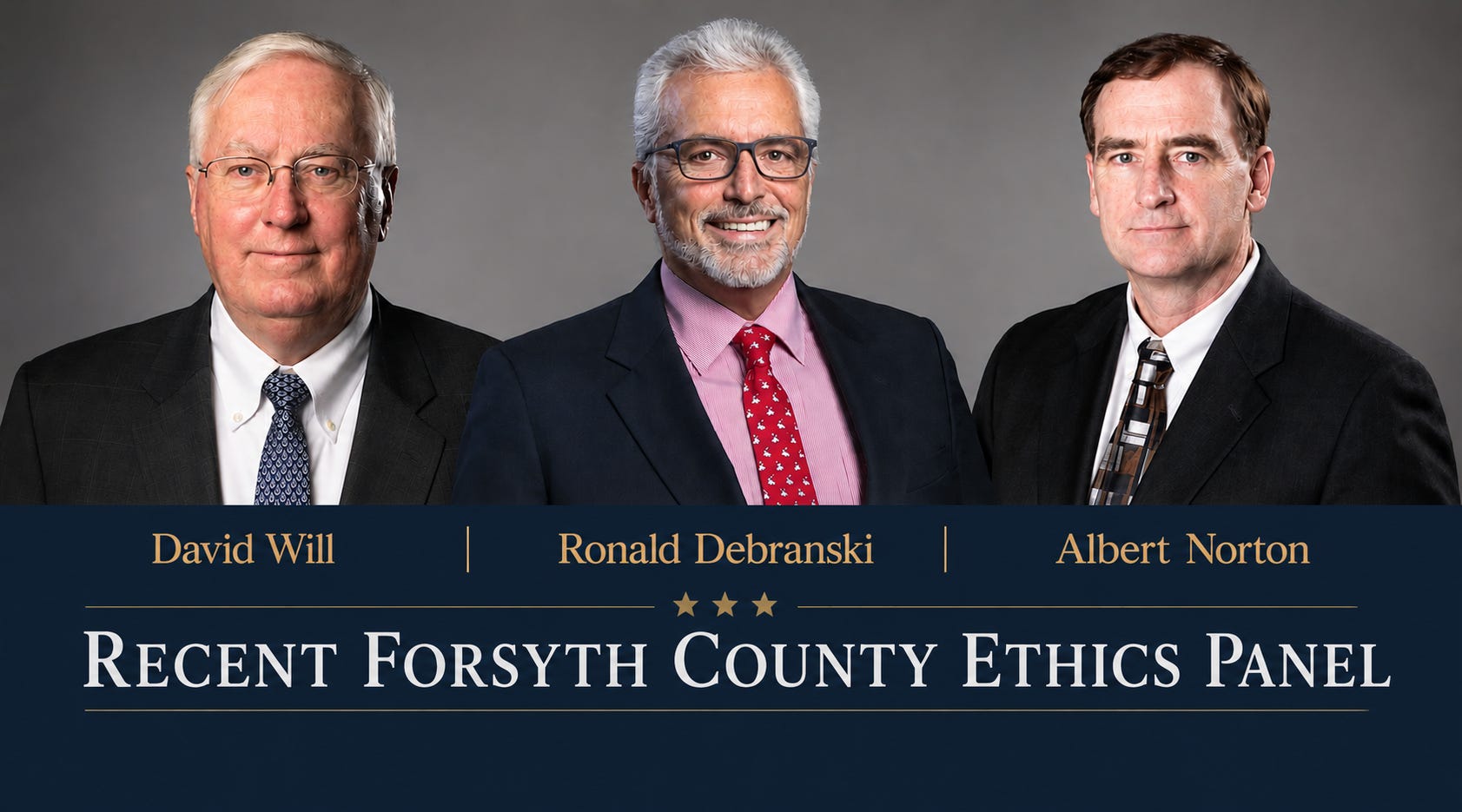
I took the opportunity to attend last Monday’s ethics panel reconvening. In the photo below, on your right you will see (L-R) the three ethics panel members, Ronald Debranski, David Will, and Albert Norton. On the left side of the table, hidden from view is Forsyth County Ethics Clerk Brandi Zuckerman. Between Ms. Zuckerman and the camera you will identify Attorney Christopher Balch, the individual whose unauthorized and conflicted participation during the initial investigatory review was the centerpiece of Mr. Howard’s motion to dismiss, the only issue before the panel at the second meeting.
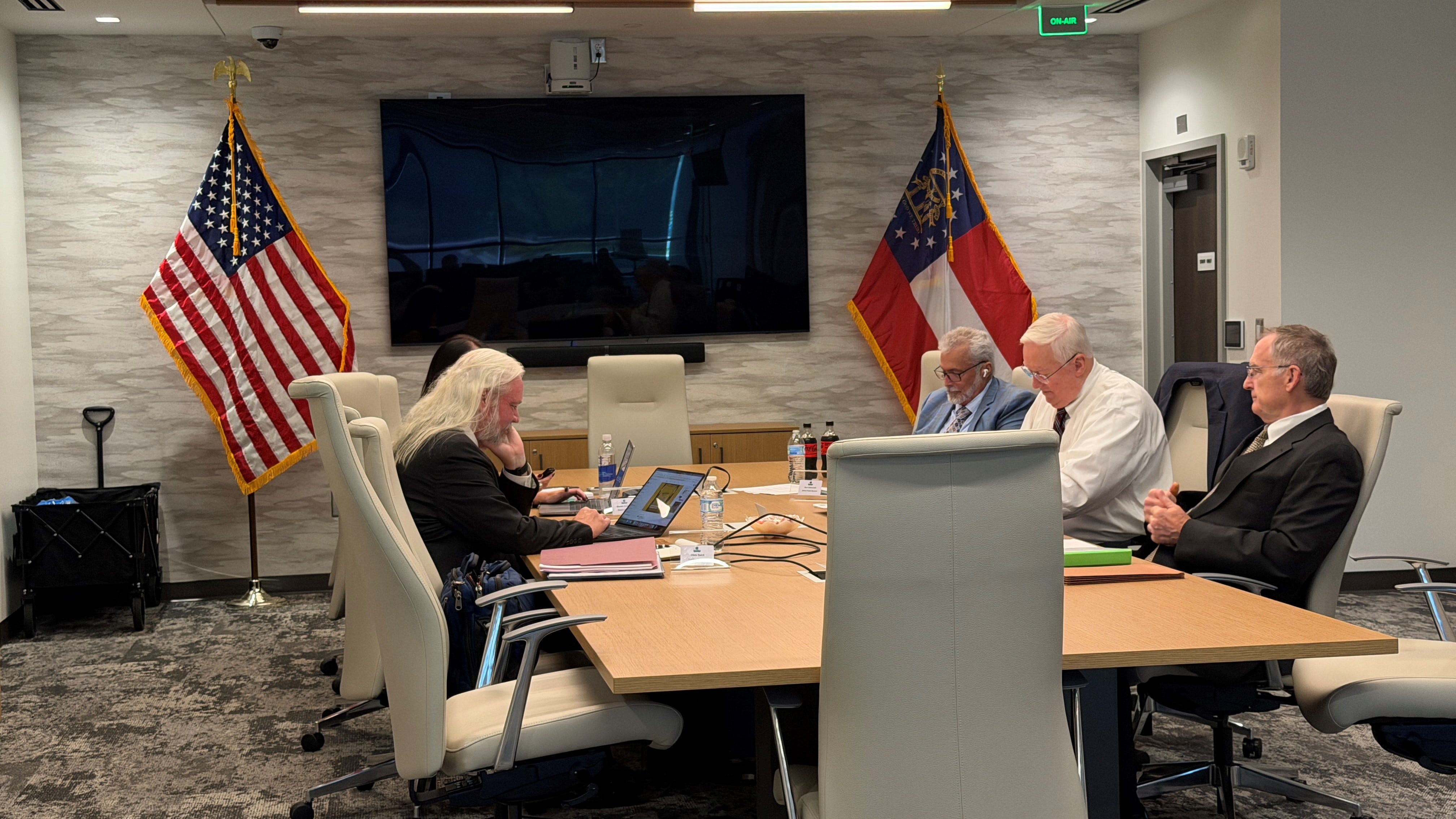
Out of town when notified, Mr. Howard would have had a hardship of traveling a twelve-hour round trip to attend the meeting, and would not have been allowed to speak or participate in any event. That Mr. Howard therefore did not attend, however, would seemingly be held against him by the three panelists, each agreeing aloud that they would have wanted to hear from Mr. Howard, even though doing so would be an ethics rules violation on their parts, no different, however, than allowing the conflicted attorney Balch to sit and address them as he had then done twice. Attending the discussion from my seat approximately thirty feet away, I spoke up and personally offered to place a call to Mr. Howard so that they panel could hear from him as they expressed desire, and was immediately rebuffed by Mr. Will. That told me how much the panelists really wanted to hear from Mr. Howard.
Although the motion being considered at this second meeting involved the unauthorized and conflicted participation of Mr. Balch in the first meeting, there seated across from the panelists once again was Mr. Balch, the three panelists allowing yet another round of unauthorized and conflicted interests to take part in dealing with the issue before them. And almost unbelievably, as those of us who gathered to witness this meeting would learn, Balch, the appointed Forsyth County Ethics attorney, hired by the orchestrated efforts of the six Respondents to Mr. Howard’s complaint, had been entrusted by this presumably neutral ethics tribunal, to write the decision exonerating the very appointers who put him there in the first place, and who therefore had the power to hire him, and even to fire him if dissatisfied with the product of his work!
As the meeting played out, the audience discovered that Mr. Balch brought with him a draft document of the initial case dismissal, apparently written by his hand, for the three panelists to consider and sign. Importantly, the panel itself did not author its own decision. Instead Balch, appointed to his position by the Respondents to Mr. Howard’s complaint, apparently was responsible for writing the exoneration of his appointers!
Stupid Defense at Work During and After the Meeting
During the meeting, I personally observed the three-member panel, each member alleging confusion as to the reasoning behind Mr. Howard’s motion to vacate the panel’s decision. Given the apparent conflicts of interests surrounding Balch’s involvement, the panel’s behavior, it seems, was simply another example of the stupid defense at work potentially shaping the outcome. Every reader who has made it this far understands the conflicts I raise, yet these three seasoned attorneys, selected ostensibly for their knowledge, independence and neutrality, portrayed themselves to be irredeemably confused by all this. For the record, the following passages, along with supporting evidence, are the grounds on which Mr. Howard voiced objections to his original complaint being dismissed with the participation and coaching of Mr. Balch:
1. Christopher D. Balch, the outside attorney engaged in connection with this matter, appears to hold concurrent attorney-client relationships incompatible with a neutral role. The County has described communications between Mr. Balch and the Ethics Clerk’s office as privileged attorney-client communications; a February 23, 2026 email asserts attorney-client privilege directly with Commissioner Laura Semanson, a named respondent. The same attorney cannot serve the County’s interest in an impartial proceeding and a respondent’s personal interest in defeating it. (Attachments 1-2.)
2. A determination dismissing a related complaint was issued by counsel on February 20, 2026, before any Panel was empaneled — although under the Panel’s own published Investigatory Review Procedure, that determination belongs to the Panel, not to counsel.
3. The resolution appointing Mr. Balch was adopted December 4, 2025 by a vote that included four of the named respondents. (Attachment 3.)
In addition, I was not afforded proper notice or service of the proceeding that led to this determination. The County Attorney was aware that I was out of town — a separate property matter involving me had been continued on that basis — yet I received notice only by email, approximately 36 hours before the hearing, sent on [the date of the primary runoff election]. I was never served in the manner the process requires. A determination reached without adequate notice and an opportunity to be heard cannot fairly stand.
After the meeting adjourned, I approached Mr. Will and questioned Mr. Balch’s jurisdiction argument due to the fact that the ethics ordinance provides the jurisdiction for the panel to issue findings of fact and conclusions of law as the basis of judging ethical behavior, and that according to the ordinance, law-breaking in the activities of one’s job with the county is itself an ethical violation. Mr. Will’s response was circular, saying, “Only if you have jurisdiction.” I immediately countered that the jurisdiction is defined right there in the ordinance, to which Mr. Will begged off, gathering his things and leaving the room, his response and actions, in my opinion, defining a final example of the stupid defense at work that day.
In his complaint, Mr. Howard provided certifying evidence tying Mr. Balch’s personal interests to the interests of each Respondent in the Howard complaint. Yet, these three ethics panel members acted as if they could not understand what Mr. Howard was talking about. I personally do not buy the panel’s ignorance in this matter. The conflicts of interest between Mr. Balch, the county attorney, the county manager and four commissioners, each who played their respective parts in appointing Balch, each who benefited from that appointment, and each who are named as Respondents in Mr. Howard’s complaint, would be obvious to any bright third-grader.
Lessons for Forsyth County Citizens
Forsyth County citizens should take note that their county is being run by the very officials cited in Scott Howard’s ethics complaint. Citizens should also note how difficult it is to enact justice against public officials who not only hold power over all who are employed by the county, but who also have control over the public purse to pay whatever it might cost to subvert the system in defending themselves.
In times like these, I am reminded of John Adams who wrote:
“Our Constitution was made only for a moral and religious people. It is wholly inadequate to the government of any other.”
A parallel argument might be made that a community’s local ordinances are made for only honest public officials, and are wholly inadequate for the government of any other. In appointing Mr. Balch, Forsyth County commissioners used governmental power in ways the ordinances do not authorize. 250 years ago, our founders recognized that the use of governmental power without authority is the definition of tyranny. Until the people act to stem that kind of behavior, it will continue and fester. It is time for the people to clean out Forsyth County Government and restore honesty and accountability to those public offices.
Thanks Hank for another great article. I wish more people in FoCo had your ideals. I have always heard that this county is run by the ‘good ole boy’ network, ever since I moved here. Everyone seems to know everything’s corrupt but no one seems to really want to do anything about it. I applaud you for your efforts and again, thanks for keeping the citizens informed.
That all persons involved seem to have no ethics, it is laughable that they try so hard to prove they do have such ethics! And then "prove" it in an unethical way. Thanks, Hank, again for your time and talent in exposing our county government.