

County Ethics Attorney Post Has Become a Revolving Door
In my recent article entitled, “How the Forsyth County Commission Used Public Funds to Bail Themselves Out of Ethics Charges,” I described how Forsyth County senior staff, and the county attorney, have been working in concert with four commissioners, each of those officials playing a particular role in an apparent effort to shield themselves from meaningful ethics accountability.
But, isn’t it ironic when an attorney apparently appointed to shield county commissioners and executive staff from ethics complaints, finds himself embroiled in ethics complaints just like his appointers, and has to be dismissed? The newly-created office of “county ethics attorney,” which has never existed in the history of Forsyth County, has now become a veritable revolving door, whoever walking through it soon discovering that the very services he or she is appointed to provide are contrary to the intent of the county ethics code, and violate the authorities and procedures the code prescribes. So, unless the ethics rules are changed, practically any intervening activity a “county ethics attorney” might undertake, which usurps authority the code specifically assigns to other office holders, or which alters the flow of prescribed ethics procedures in any way, could become cause for a new complaint.
Ethics Standards Apply to all County Personnel-Even the Ethics Attorney
Forsyth County maintains a rigid set of ethics standards, rules of you will, applicable to all county officials and employees. According to the Forsyth County Ethics Code, those rules specifically apply to “the board of commissioners, any member of a board or authority appointed by the board, the county manager and assistant administrator, the county attorney and any of his assistant county attorneys, any other elected or appointed officer or employee of the county.” Thus, no one at the county is exempt from ethics rules and responsibilities, not even a county ethics attorney.
According to those rules, anyone can file an ethics complaint when he or she feels one or more of the parties subject to the ethics rules have violated the county’s standards. When that happens, a process prescribed within those same rules must take place. That process is designed to remain free from influence of interested parties, especially those against whom an ethics complaint might be filed, but also free from the person or persons filing a complaint. The principle of independence is the foundation of the Forsyth County Ethics Code. When the processes conducted under the ethics rules do not remain independent, the system breaks down.
Forsyth County Ethics Program is Broken
Under the control of a cast of the following four county commissioners, Alfred John, Kerry Hill, Laura Semanson and Mendy Moore, the Forsyth County Ethics Code has broken down. Over the past several months, I have documented for you an apparent ongoing attempt by those four commissioners, aided by senior staff and the county attorney, to systematically override the independence necessary for the ethics processes to yield equitable outcomes. The apparent subversion of the ethics rules has been carried out by the six working together to interpose an appointed “gatekeeper,” to supervise the ethics process. From that post, one incidentally not authorized by the ethics code, the commissioner’s new “county ethics attorney” could be positioned to effectively quash any complaint filed against the aforementioned office holders. What the commissioners apparently did not anticipate, however, is that the office holder apparently appointed to dismiss complaints filed against them, attorney Christopher Balch, by virtue of various activities he has undertaken within that appointment, has himself become the subject of ethics complaints. The ethics rules to not sanction the appointment of anyone to intervene, and thus possibly taint the independence of the prescribed ethics procedures. The interposition of such a “gatekeeper” to overlord and affect the independent ethics process is itself a violation of the very rules such an officer is appointed to oversee. Thus, any such appointee who affects the independence of the ethics processes from such a post can easily find himself the subject of related ethics complaints.
Because the commissioner’s so-called “county ethics attorney” has now himself become the respondent in at least two ethics complaints related to his work at that position, attorney Balch cannot presently participate in his role of the commissioner’s gatekeeper. And because the commissioner’s previous appointee is disqualified from gatekeeping complaints, especially concerning his own vulnerability to the rules, this past Thursday, out of apparent desperation to keep their gatekeeping operation functioning, those same four commissioners, along with the county manager and a representative of the county attorney’s firm, proposed and passed a new resolution, this time appointing a different law firm into the same ethically-challenged gatekeeper position Mr. Balch formerly occupied, as if becoming “the next contestant on the Price is Right.”
The new firm, Carothers & Mitchell, LLC, specifically including attorneys Thomas Mitchell and Cullen B. Threlkeld, appointed for the published purpose of “providing legal guidance and support to the Ethics Panel Clerk and Ethics Panel,” has been assigned to replace Mr. Balch, and will now be subject to the same rules as Balch, who is apparently out the door.

The idea of an attorney providing legal guidance to a three-attorney ethics panel, effectively situates a fourth attorney onto the panel, which violates the code no matter how anyone would like to couch it. Thus, depending on what activities the new “contestant” undertakes, he (they) could become the subjects of ethics complaints, just like Mr. Balch. For that reason, we can expect that the crew of Balch replacements may choose to operate more discretely to avoid the same fate as their predecessor.
One major obstacle the new team will face is that the tasks associated with the position they are designated to fill, cannot be carried out without varying from the mandated ethics procedures prescribed in the code. The code sanctions no “county ethics attorney” to intervene in an otherwise straightforward process purposely designed to be carried out by a layperson who is not an attorney, and who is tasked only with following an uncomplicated set of discrete, clerical tasks.
How the Forsyth County Ethics Rules Are Supposed to Work
And so, let’s discuss how the ethics complaint process is supposed to work. Once you understand that, I expect you will be able to see how the newly-devised gatekeeping operation works outside of the code’s prescribed independent procedures. According to the Forsyth County Ethics Code, when a complaint is filed it is received by an individual charged with the responsibilities of the “ethics panel clerk.” As the title indicates, that office is a clerical one. The tasks assigned to that person are solely administrative and secretarial in nature. They are not tasks requiring an attorney’s formal education and training.
According to Ethics Code Section 2-112(e), once a complaint is filed, the first task the ethics panel clerk must perform is “determining that an ethics complaint meets the facial requirements of section 2-124 of this Code of Ethics.” Facial requirements are surface requirements. They do not require legal analysis, professional training or skills beyond possessing a good mind and a willingness to follow a few straightforward instructions. If the ethics panel clerk determines that a complaint is “technically deficient,” meaning that it does not meet one or more of the “facial requirements,” the ethics panel clerk must notify the complainant of those specific “technical deficiencies” and provide that party seven days to correct those deficiencies before dismissing the complaint on “technical grounds.”
The facial requirements the ethics panel clerk is empowered to judge do not require legal analysis or interpretation. They are simply boxes to check on the following checklist:
Is the complaint signed and notarized?
Is the complaint supported by affidavits based on personal knowledge?
Does the complaint pertain to conduct occurring more than six months prior to the complaint being filed or contain no statement that the conduct was concealed or non-disclosed?
Does the complaint specifically identify the provisions(s) of the Code of Ethics alleged to have been violated by exact code number?
Does the complaint provide a detailed explanation of why the alleged conduct constitutes a violation?
Does the complaint contain the full legal name, mailing address, or phone number of the complaining party?
Does the complaint contain the following statement: “I have read the ethics complaint and aver that the facts contained therein are true to the best of my knowledge and belief.”
That’s it, very simple and hardly time-consuming. None of those checklist items, which are designed to be administered by the ethics panel clerk, requires any particular skill or training beyond that of a layperson—a clerk. The ordinance is written that way because the facts and arguments of an ethics complaint are not to be adjudicated at the level of a layperson. Facts and arguments are reserved to be analyzed and judged by seasoned attorneys comprising a three-member ethics panel.
Once the ethics panel clerk has determined that all facial requirements pertaining to a complaint are met, and that the complaint is therefore not “technically deficient,” the ethics rules require the clerk to “conduct a blind drawing of three names from the list of members and contact each member to determine their availability to serve on the ethics panel.” Next, “upon selection of three qualified members who are available to serve on the ethics panel, the clerk shall prepare a document identifying panel membership and both the clerk and the county manager and/or county attorney that witnessed the selection process shall attest on that document as to the legitimacy of the selection process.”
Notice the county ethics rules do not empower anyone other than the ethics panel clerk to administer the process I just described. Should anyone else, such as an individual appointed as a gate-keeping “county ethics attorney,” interject him or herself into judging the facial requirements of a particular complaint, that activity could only be undertaken from outside of the county ethics rules, effectively casting those rules to the wind. And it is the alleged overriding of processes prescribed by the county ethics rules, Mr. Balch apparently usurping the authority of the ethics panel clerk, and interjecting himself as a fourth attorney on a three-attorney ethics panel, that have provided the grounds for the ethics complaints presently filed against him.
Thus, as of last Thursday, Forsyth County taxpayers are apparently paying a veritable team of attorneys to provide very much the same questionable gate-keeping services previously carried out by Mr. Balch. Those services hardly accrue benefit to the citizens of Forsyth County. They are legal services specifically designed to mask and defend against allegations of unethical conduct by four commissioners, the county manager and county attorney. County ethics rules require respondents to ethics complaints to pay any costs of legal defense against such complaints out of personal funds, and limit reimbursement of those costs at $10,000. Reimbursement is authorized only if every allegation is dismissed by the ethics panel. Perhaps you see the commissioner’s motivations in all of this.
Ignoring Ethics Rules, Commissioners Delegate Prescribed Ethics Panel Clerk Responsibilities to New Gatekeepers and Assign New Law Firm as Fourth Attorney in a Three-Member Ethics Panel
One vital provision in the Forsyth County Ethics Code is that any person under it’s authority, including commissioners and county attorneys, in performing the responsibilities of their positions, must, “Uphold the Constitution, laws, and legal regulations of the United States and the state and of all governments therein and never be a party to their evasion.” In appointing the new gatekeeping firm to its responsibilities, however, all five commissioners, the county manager and county attorney who wrote the resolution, have arguably violated that provision, potentially nullifying their resolution of appointment. The Forsyth County Ethics Code PRESCRIBES certain tasks to be carried out by an office holder it describes as the “ethics panel clerk.” The ethics code anticipates that the ethics panel clerk, a layperson, will personally carry out those tasks. As we have discussed, the tasks associated with the ethics panel clerk amount to checking boxes in a checklist. Those tasks are not overly burdensome or time consuming. In last Thursday’s resolution, the commissioners relieved the ethics panel clerk of “part of the administrative burden associated with the current volume of ethics complaints.” They did not specify which part of the so-called “burden” the ethics panel clerk would be relieved. But that does not matter because the entire “burden,” if that term even applies, is PRESCRIBED to be administered by the ethics panel clerk in the ordinance. Thus, in doing so the commissioners have arguably evaded the ethics ordinance, which places them at jeopardy of even more ethics complaints.
Furthermore, in the new resolution the commissioners stated their intention that the new gatekeepers “provide legal guidance and otherwise support and assist the Ethics Panel Clerk and Ethics Panel in carrying out their respective responsibilities under the Forsyth County Code of Ethics.” The duties of the ethics panel clerk do not require legal determinations. The ethics panel clerk therefore does not require “legal guidance” in carrying out that office’s responsibilities. The assignment of a law firm to provide legal guidance to an individual whose sole responsibility is to check discrete boxes on a simple checklist, wreaks of the possibility that the commissioners intend for the law firm to interfere with the work of the ethics panel clerk and find ways to affect the clerk’s final determinations.
And by assigning certain attorneys to “provide legal guidance” to a three-attorney ethics panel, not only does the resolution defy the rules by effectively placing a fourth attorney on a three-attorney panel, but the commissioners also admit in their own words that this resolution is an attempt to GUIDE the panel toward certain outcomes, adversely affecting the independence of the ethics process codified in the ordinance.
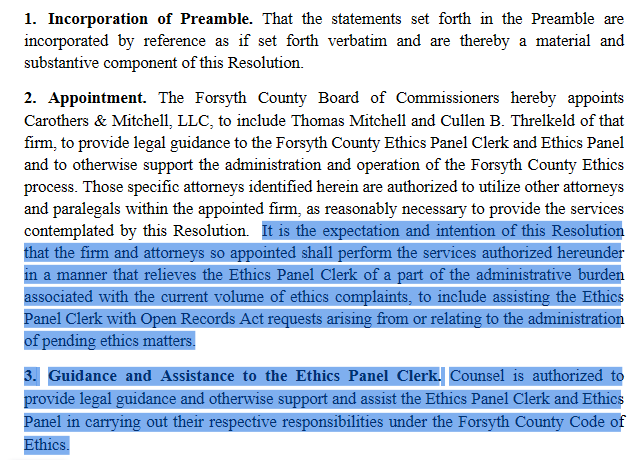
Ethics code Section 2-61(d) provides the intent that “It is essential to the proper operation of democratic government that public officials be independent and impartial, that governmental decisions and policy be made in the proper channels of the governmental structure.” Last Thursday’s resolution arguably violates that intent, removing the independence of the ethics panel clerk from performing the duties of that office without extraneous “legal guidance,” and adversely affecting the intent that the decisions of the clerk’s office be made in that office and not be channeled to or through, or be affected by office holders in other offices.
As the appointment resolution it was passed last Thursday, it will be difficult for Mr. Balch’s replacements to provide the services it describes, without breaking existing ethics rules. That is because those rules do not authorize any parties, except the ethics panel clerk and the three-member ethics panel to affect their assigned purposes. Any tangible effect by the new firm on the processes prescribed under the ethics rules, or designated to the individuals authorized to carry out those processes, could land that firm and its attorneys in the same place as Mr. Balch, engulfed in ethics allegations themselves. Will they remain clear of those rules, or will they simply become “the next contestants on The Price is Right?” Time will tell. Stay tuned…
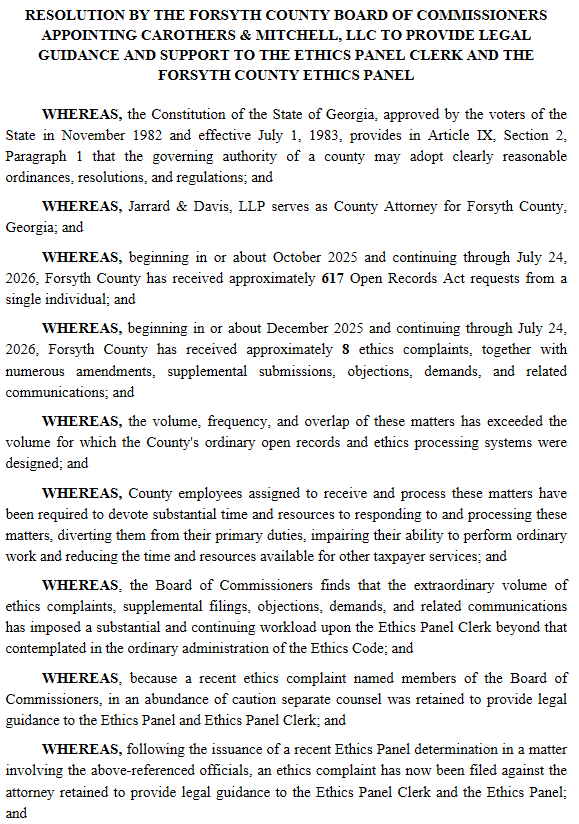
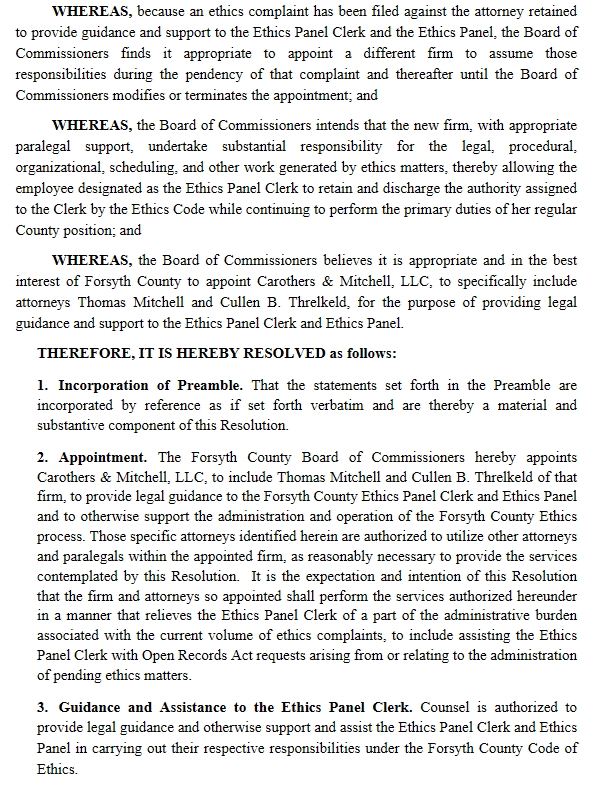
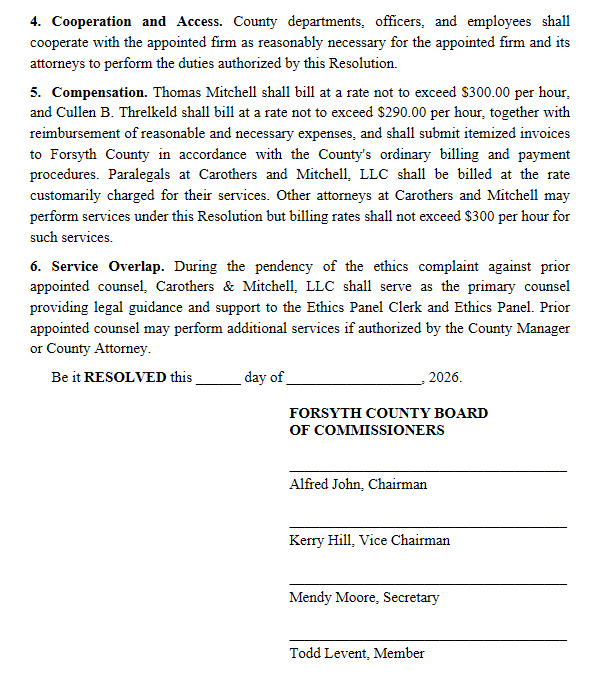
Below you will find the entire resolution unanimously passed by the Forsyth County Commission last Thursday:
Thank you Hank. Keep up the great work!
Thank you Hank. Based on what I just read I should apply and become the ethics clerk. I have no business or fiduciary or personal dealings with any of these parties and have the administrative background to take the job. I could save the county a lot of money. I would need a salary of $60k non exempt and I can't be bought or aggravated. I have no family, literally. So you can't get to them. I don't even have a dog. I have no affiliation with any attorneys. Hired a few, they were worthless, except for one. So no conflicts exist. I know SEC ethics laws backwards and forwards.
Thoughts? As I am unemployed for over a year, my skills more than fit any administrative criteria.